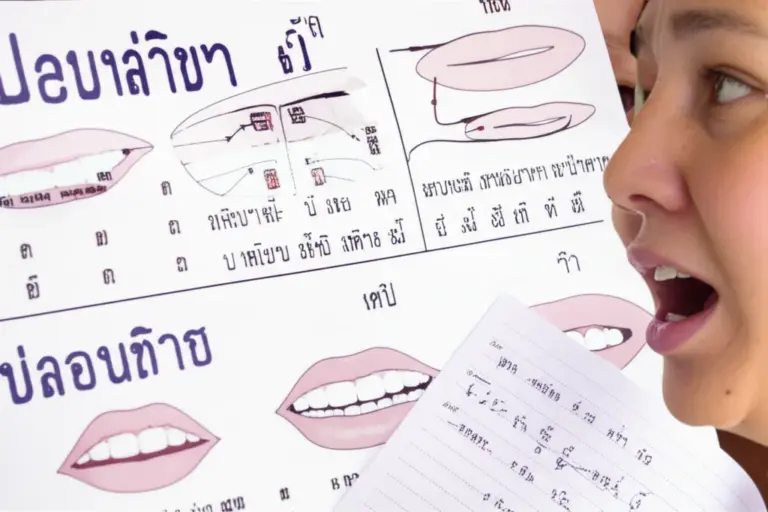
Practical Pronunciation Tips and Romanization: How to Say It Right, Common Mistakes, and Simple Exercises to Improve Your Thai Accent
- Practical Pronunciation Tips and Romanization: How to Say It Right, Common Mistakes, and Simple Exercises to Improve Your Thai Accent
Welcome to the Land of Smiles! As a tourist, mastering a few basic phrases goes a long way in Thailand. However, Thai is a tonal language, meaning the slightest variation in pitch can change a word’s meaning entirely. This guide provides essential Thai pronunciation tips for tourists to help you communicate clearly, order your favorite dish correctly, and show respect to the local culture. Forget confusing Romanization for a moment—we’ll break down the core elements that truly make a difference in your accent.
Welcome to the World of Thai Sounds: Why Pronunciation Matters
Mispronunciation in Thai isn’t just awkward; it can lead to confusion or, worse, offense. For instance, the word for ‘close’ (ปิด, pìt) and the word for ‘ghost’ (ผี, phĭi) share similar sounds but rely entirely on tone and aspiration to differentiate them. By focusing on correct pronunciation from the start, you enhance your travel experience and foster better interactions with locals.
The Four Pillars of Correct Thai Pronunciation
To achieve a passable Thai accent, you must focus on these four foundational elements, which are often absent or ignored in English.
Pillar 1: Mastering the Five Tones
Thai has five distinct tones: Mid, Low, Falling, High, and Rising. This is the single most challenging aspect for visitors, yet it is non-negotiable for clarity. Practice contrasting minimal pairs (words that sound identical except for the tone) to train your ear.
| Tone | Description | Example (Romanization) |
|---|---|---|
| Mid (ma) | Flat, even tone (like normal speech). | maa (มา – to come) |
| Low (mà) | Starts low and stays low. | màa (หมา – dog) |
| Falling (mâ) | Starts high and drops sharply. | mâa (ม้า – horse) |
| High (má) | Starts high and stays high. | máa (ม้า – horse) |
| Rising (mă) | Starts low, dips slightly, and rises high. | măa (หมา – dog) |
Pillar 2: Vowels and Length (Short vs. Long)
Thai vowels come in pairs: short and long. Confusing them can change the word. For example, ดี (dii, long ‘i’) means ‘good,’ but ดิ (di, short ‘i’) is just a sound particle. Always ensure you are extending the long vowels (indicated by double letters in many Romanization systems).
Pillar 3: Consonants That Change Everything (Aspirated vs. Unaspirated)
English speakers struggle with the difference between aspirated (a puff of air, like the ‘p’ in ‘pin’) and unaspirated (no puff of air, like the ‘p’ in ‘spin’) consonants. In Thai, these are separate sounds. ‘P’ and ‘ph’ are two different letters. If you say ‘Pai’ (ไป – to go) with too much aspiration, you might be misunderstood. Practice holding a piece of paper in front of your mouth: if it moves when you say the sound, it’s aspirated (e.g., ‘ph’, ‘th’, ‘kh’).
Decoding Romanization: What to Watch Out For
Romanization—writing Thai sounds using the Latin alphabet—is notoriously inconsistent. This is why focusing on the actual sound, rather than the spelling you read on a street sign, is crucial for Thai pronunciation tips for tourists.
The Problem with Unofficial Romanization
Many common place names are transliterated based on historical or colloquial spellings, not phonetic accuracy. The most famous example is ‘Phuket.’ While the ‘ph’ often indicates an aspirated ‘p’ sound, here it is pronounced simply as a ‘P’ sound, just like in ‘pool’ (Poo-ket). Similarly, ‘Pattaya’ is often closer to ‘Pàt-tá-yaa’ than ‘Pat-tay-aah’. Always listen to the local pronunciation if possible.
The Royal Thai General System (RTGS): A Quick Guide
The official RTGS is used by the Thai government but rarely includes tone markers, making it incomplete for language learners. However, understanding its basics helps:
- RTGS uses ‘ph’ for the aspirated P sound, and ‘p’ for the unaspirated P sound.
- It uses double vowels (e.g., ‘aa’, ‘ee’) to indicate long vowel sounds.
- ‘Ch’ is used for the ‘ch’ sound (as in ‘church’).
Common Pronunciation Pitfalls for English Speakers
Avoid these common traps to instantly sound more native:
- Final Consonants: Thai final consonants are rarely released. When you say ‘Khráp’ (the polite male particle), the ‘p’ should be stopped abruptly, almost like a silent ‘p’. Do not release the air. This applies to final ‘t’, ‘k’, and ‘p’ sounds.
- The ‘R’ sound: Many Thais, especially in conversation, use an ‘L’ sound instead of the rolling ‘R’. Don’t worry about perfecting the Thai rolled ‘R’; an ‘L’ is often acceptable and sometimes preferred in casual speech.
- The ‘A’ Vowel: The Thai ‘a’ sound (short ‘a’ like in ครับ khráp) is often closer to the vowel sound in ‘up’ or ‘but’ in English, not the ‘a’ in ‘cat’.
Simple Exercises to Improve Your Thai Accent
Tone Practice: The ‘Khao’ Family
Practice these four words, focusing only on the pitch changes:
- ขาว (kăao): White (Rising tone)
- เข้า (kâo): To enter (Falling tone)
- ข้าว (khâao): Rice (Falling tone, but note the aspiration ‘kh’)
- ข่าว (khàao): News (Low tone, aspirated)
Listen to a native speaker pronounce these words repeatedly until you can distinguish the subtle shifts.
Another excellent exercise for improving your Thai accent is focusing on the polite particles. Men use khráp (ครับ) and women use khâ (ค่ะ). Always include these at the end of sentences to show respect. Practice saying them with the correct tone and the unreleased final consonant sound (the ‘p’ in khráp is silent).
Khráp (ครับ)
Low tone, unreleased ‘p’.
Khâ (ค่ะ)
Falling tone. Often shortened to ‘ka’ in casual speech.
Note: The female particle for questions is high tone: Khá? (คะ?)
คำถามที่พบบ่อย (FAQ)
Is it okay if I miss the tone sometimes?
While Thais are generally forgiving of foreigners, missing the tone can lead to serious misunderstandings. For simple tourist phrases, context often helps, but for key vocabulary (like numbers, directions, or food names), precision is essential. Aim for the correct tone, especially the Rising and Falling tones, as they are the most distinct.
Which Romanization standard should I follow?
For reading signs, you must rely on the unofficial spellings you see (like ‘Phuket’). For learning vocabulary, use a system that includes tone markers (like the standard used in this article, which is derived from the Paiboon system) to ensure you learn the correct pitch from the beginning.
Why do some Thais pronounce ‘R’ as ‘L’?
In Bangkok and casual Thai speech, the rolled ‘R’ sound is often replaced by an ‘L’ sound due to natural linguistic drift. For tourists, adopting the ‘L’ sound for ‘R’ is acceptable and will likely make you sound more natural than trying to force an incorrect rolled ‘R’.
References
- Learning Basic Thai Phrases: A Traveler’s Cheat Sheet — Essential Survival Phrases, Pronunciation Tips, and Cultural Do’s & Don’ts for First-Time Visitors
- Why Learn Thai Basics Before You Travel? Understanding Search Intent, Key Phrase Types, and When to Use Them
- Must-Know Survival Phrases for Travelers: Greetings, Directions, Numbers, Ordering Food, and Asking for Help (with Pronunciation Guides)