Thai Currency Guide for Koh Tao: How to Exchange Money and Pay
Koh Tao is a stunning destination, but being an island, it has specific financial quirks that every traveler should understand before arriving. This Thai currency guide for Koh Tao is designed to help you navigate exchange rates, ATMs, and payment methods effectively so you can focus on your diving and beach time rather than hunting for cash. While Thailand is increasingly digital, Koh Tao remains a place where cash is king, and preparation is key to avoiding unnecessary fees.
Thai currency guide for Koh Tao: Understanding Thai Currency Basics
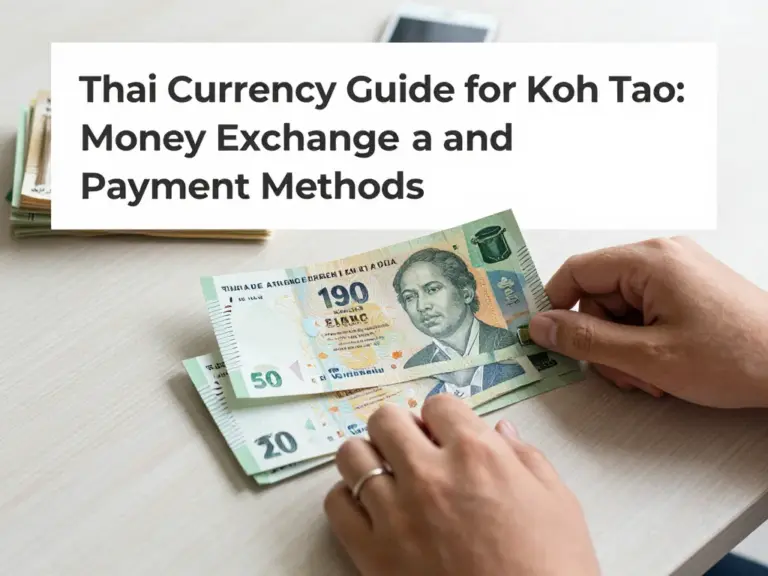
The local currency is the Thai Baht (THB). Banknotes come in denominations of 20, 50, 100, 500, and 1,000 Baht. Coins are used for smaller amounts (1, 2, 5, and 10 Baht). It is highly recommended to keep smaller denominations on hand, as many small shops and street food vendors on Koh Tao may struggle to provide change for a 1,000 Baht note, especially early in the day.
Managing Money: ATMs vs. Currency Exchange
When you arrive on the island, you will find that your financial strategy needs to be balanced between convenience and cost-efficiency. Here is how to handle your money effectively.
Using ATMs on Koh Tao
ATMs are widely available in the main areas of Sairee Beach, Mae Haad, and Chalok Baan Kao. However, be aware that Thai ATMs charge a significant flat fee for international cards—currently around 220 THB per withdrawal, regardless of the amount. To minimize this, withdraw the maximum amount allowed per transaction to reduce the impact of the fixed fee.
Currency Exchange Booths
There are several legitimate currency exchange booths (often operated by major Thai banks like Kasikorn or Bangkok Bank) located near the piers in Mae Haad. Rates here are generally fair, but they are typically slightly lower than what you might find in Bangkok. It is advisable to exchange a sufficient amount of cash on the mainland if you are arriving from Bangkok or a major city.
Payment Methods: Cash vs. Digital
| Payment Method | Availability on Koh Tao | Best Used For |
|---|---|---|
| Cash (THB) | Universal | Street food, small shops, diving schools, tips |
| Credit/Debit Cards | Limited | High-end resorts, some dive centers, supermarkets |
| PromptPay/QR Code | Moderate | Cafes, some restaurants, local services |
Checklist for Financial Preparation
Before you head to the pier to catch your ferry, ensure you have ticked off these financial essentials:
- Notify your bank: Ensure your bank knows you are traveling to Thailand to prevent card blocks.
- Carry a backup card: Always have a second card from a different account/provider just in case of loss or technical issues.
- Bring clean, crisp bills: If you are bringing foreign cash to exchange, ensure notes are unmarked and undamaged, as exchange booths may reject damaged currency.
- Download a currency converter: Use an offline-capable app to keep track of spending in your home currency.
- Prepare for the 220 THB fee: Factor this ATM fee into your budget so it doesn’t come as a surprise.
Avoiding Common Pitfalls
One major mistake travelers make is assuming that credit cards are accepted everywhere. While many dive centers and hotels accept cards, they often add a 3% surcharge to cover merchant fees. Always ask before you pay. Additionally, never rely solely on digital payments like QR codes if you are a tourist without a local Thai bank account, as these systems are often locked to local users.
Conclusion
Navigating finances on Koh Tao is straightforward if you prioritize cash and plan for ATM fees. By following this Thai currency guide for Koh Tao, you can ensure your trip remains stress-free and financially sound. Keep a mix of cash and cards, notify your bank, and enjoy the island life without worrying about your wallet.
Frequently Asked Questions (FAQ)
A: No, cards are not accepted everywhere. While large resorts and some dive schools accept them, small local businesses and street vendors are cash-only. Expect a 3% surcharge for card payments.
A: This depends on your lifestyle, but for a moderate budget including food and activities, having 1,500 to 2,500 THB per day in cash is a safe buffer.
A: Generally, exchanging at a reputable bank booth in Bangkok or at the airport is better than exchanging on the island, as rates on Koh Tao can be slightly less competitive due to the logistics of transporting cash to the island.