Why Khon Mask Painting Matters: History, Cultural Significance, and What Makes Bang Sai Special
Khon mask painting is not merely a decorative craft; it is a profound expression of Thai identity and spiritual heritage. As the face of Thailand’s most prestigious performing art, the Khon mask serves as a bridge between the earthly and the divine. For travelers exploring Thailand Tourism, understanding the intricate process of creating these masks offers a deeper appreciation for the nation’s artistic soul. Specifically, the Bang Sai Arts and Crafts Center in Ayutthaya stands as a beacon for preserving this meticulous tradition, ensuring that the legacy of the Ramakien lives on through the hands of master artisans.
The Historical Roots of Khon Mask Painting
The history of Khon mask painting is inextricably linked to the Khon dance-drama, which dates back to the Ayutthaya period. Originally performed exclusively for the royal court, Khon tells the story of the Ramakien—the Thai epic based on the Indian Ramayana. The masks were developed to allow performers to embody various characters, including heroes, demons, and monkeys. Each mask is a masterpiece of symbolism, where colors, facial expressions, and crown shapes denote the specific rank and lineage of the character. Over centuries, the techniques of mask-making have been passed down through generations of royal craftsmen, maintaining a standard of excellence that defines Thai high art.
Cultural Significance: More Than Just a Costume
In Thai culture, Khon mask painting carries a sacred weight. The masks are treated with the utmost respect, often kept in high places and honored with ‘Wai Khru’ ceremonies (paying respect to teachers). The act of painting a mask is considered a meditative process, requiring precision and a deep knowledge of traditional iconography. For example, the green face of Phra Ram represents virtue and divinity, while the white face of Hanuman symbolizes loyalty and supernatural power. By preserving these specific visual cues, artisans ensure that the moral lessons and cultural narratives of the Ramakien remain accessible and vibrant for modern audiences.
What Makes Bang Sai Arts and Crafts Center Special?
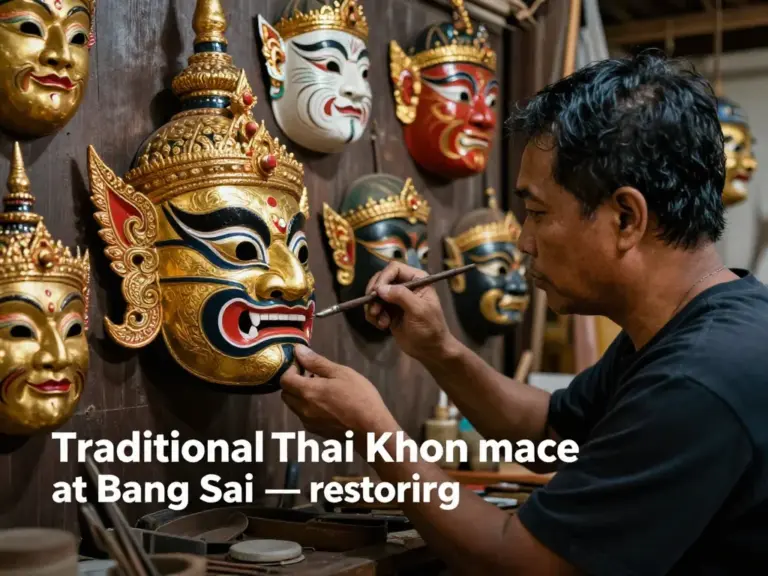
Located in Ayutthaya, the Bang Sai Arts and Crafts Center (under the Royal Patronage of Her Majesty Queen Sirikit) is a vital institution for the survival of Khon mask painting. Unlike commercial souvenir shops, Bang Sai focuses on the authentic, labor-intensive methods of production. Here, masks are crafted from ‘Khoi’ paper, layered with lacquer, and adorned with genuine gold leaf and intricate glass inlays. Visitors to Bang Sai can witness the ‘Hua Khon’ (Khon head) masters at work, meticulously applying fine lines of Thai ‘Lai Thai’ patterns. This center provides a space where rural Thais are trained in these royal arts, providing them with a sustainable livelihood while safeguarding national heritage.
The Meticulous Process of Khon Mask Painting
The creation of a single mask can take weeks. It begins with a plaster mold, followed by the application of numerous layers of specialized paper. Once the base is dry, the ‘Rak’ (lacquer) is applied to create a smooth surface for painting. The most critical stage is the painting of the eyes and the ‘Kranok’ patterns. A steady hand is required to apply the gold leaf and the vibrant mineral pigments that give the mask its life-like glow. At Bang Sai, the focus is on maintaining these traditional materials, avoiding synthetic shortcuts to ensure the mask’s durability and spiritual integrity.
คำถามที่พบบ่อย (FAQ)
| Question | Answer |
|---|---|
| What is the main material used in Khon mask painting? | Traditionally, Khon masks are made from layers of Khoi paper, bonded with lacquer (Rak), and decorated with gold leaf and Thai silk. |
| Where is the best place to see Khon mask making? | The Bang Sai Arts and Crafts Center in Ayutthaya is one of the premier locations to see authentic, high-quality Khon mask craftsmanship. |
| Do different colors on the masks have meanings? | Yes, colors signify character traits; for example, green is for Phra Ram (the hero), and gold or red is often used for royal or demonic characters. |
| Can tourists try Khon mask painting? | Some workshops at cultural centers like Bang Sai or in Bangkok offer introductory sessions where visitors can learn the basics of Thai pattern painting. |
References
UNESCO: Khon Masked Dance Drama
Tourism Authority of Thailand (TAT)