What is Deep South batik and why Narathiwat is its cultural heart — history, significance, and search intent behind this class
- What is Deep South batik and why Narathiwat is its cultural heart — history, significance, and search intent behind this class
When one thinks of Thailand’s artistic heritage, the vibrant and intricate patterns of Deep South batik often come to mind. This traditional textile art is more than just fabric; it is a canvas that tells the story of a multicultural history, blending Malay, Thai, and Islamic influences. Among the southern provinces, Narathiwat stands out as the beating heart of this craft, preserving ancient techniques while innovating for a modern global audience.
The Historical Roots of Batik in Narathiwat
The history of Deep South batik is inextricably linked to the maritime trade routes of the Malay Archipelago. For centuries, artisans in Narathiwat have refined the art of wax-resist dyeing, a technique originally influenced by Javanese traditions but adapted to reflect local sensibilities. In Narathiwat, batik became a symbol of identity, worn during significant life events and religious ceremonies. The province’s proximity to the sea and its lush tropical landscape provided both inspiration for patterns and natural ingredients for dyes.
Why Narathiwat is the Cultural Heart of Batik
Narathiwat is considered the cultural heart because it hosts the highest concentration of traditional batik workshops that still practice hand-drawn (Batik Tulis) and block-printed (Batik Cap) methods. Communities like those in the Tak Bai district have passed these skills down through generations. The local government and royal initiatives have also played a crucial role in elevating Narathiwat batik from a local craft to a luxury textile recognized internationally.
| Feature | Description |
|---|---|
| Technique | Hand-drawn Canting and Copper Block Printing |
| Motifs | Hibiscus flowers, local marine life, and geometric Islamic patterns |
| Dyes | A mix of vibrant chemical dyes and traditional natural pigments |
Significance and Search Intent: Why Take a Batik Class?
The search intent behind learning about Deep South batik often stems from a desire for authentic cultural immersion. Travelers are no longer satisfied with just buying a souvenir; they want to understand the soul of the product. By participating in a batik class in Narathiwat, visitors engage in a meditative process that requires patience and precision. It offers a tangible connection to the artisan’s life and the historical narrative of the Deep South.
The Artistic Process: From Wax to Wonder
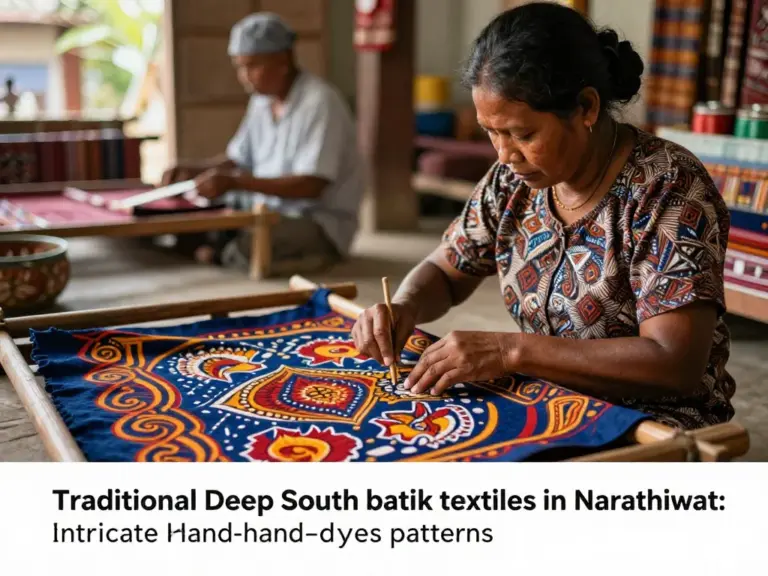
The creation of batik is a multi-stage journey. It begins with the ‘canting’ tool, used to trace intricate designs with hot wax on white cloth. This wax acts as a resist, preventing dye from reaching certain areas. After the initial coloring, the cloth is boiled to remove the wax, revealing the stunning contrast. In Narathiwat, the use of bright, sun-kissed colors reflects the warmth of the southern people and the brilliance of the Gulf of Thailand’s sun.
คำถามที่พบบ่อย (FAQ)
Explore common questions about the traditional batik of Thailand’s southern border provinces.
What makes Narathiwat batik different from Javanese batik?
While sharing roots, Narathiwat batik often features brighter color palettes and specific local motifs like the ‘Bunga Raya’ (Hibiscus) and patterns inspired by the Kolae boat, which are unique to the Thai-Malay border region.
Can tourists participate in batik workshops in Narathiwat?
Yes, several community enterprises and local studios in Narathiwat offer workshops where tourists can learn to draw their own patterns and dye the fabric under the guidance of master artisans.
Is Deep South batik considered a sustainable textile?
Many artisans in Narathiwat are moving towards sustainability by using organic cotton, silk, and natural dyes derived from local plants and barks, making it an eco-friendly choice for conscious consumers.
References
- Tourism Authority of Thailand – Southern Arts
- Sustainable Arts and Crafts Institute of Thailand
- The History and Evolution of Batik Textiles
- Deep South Batik Class in Narathiwat: Learn Traditional Motifs and Wax Techniques from Local Masters
- What traditional Narathiwat motifs you’ll learn — meanings, common patterns, and how to recognize authentic designs
- What wax-resist techniques taught in the class — step-by-step methods (canting, block printing, layering) and beginner tips