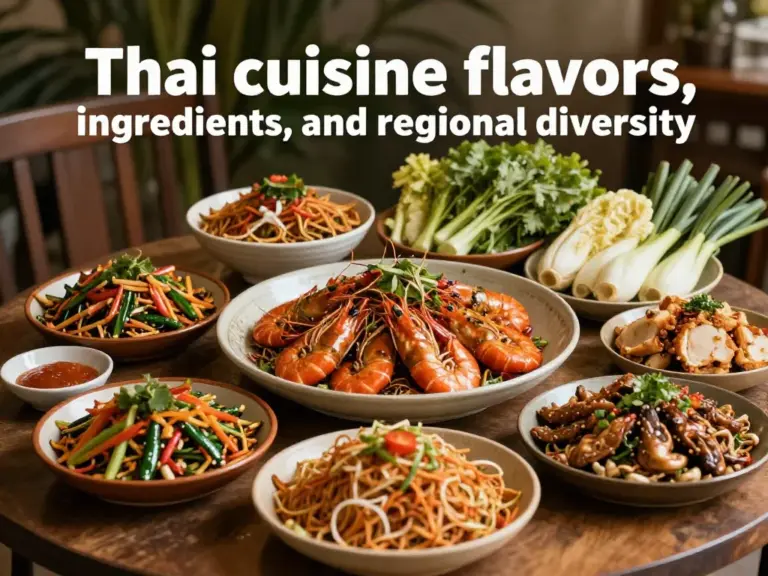
What Makes Thai Cuisine So Unique? Exploring the Flavors, Ingredients, and Regional Differences
When travelers ask, What Makes Thai Cuisine So Unique?, the answer lies in the harmonious balance of five fundamental taste senses: sweet, spicy, sour, bitter, and salty. Unlike many culinary traditions that focus on a single dominant flavor profile, Thai cooking is an intricate dance of contrasting elements that creates a complex, multi-layered experience on the palate. For any visitor exploring Thailand, understanding this gastronomy is as important as visiting the temples.
The Five Pillars of Thai Flavor
To truly appreciate the depth of Thai food, one must understand the ingredients that bring these flavors to life. Thai cuisine relies heavily on fresh herbs and aromatics rather than dried spices. Lemongrass, galangal, kaffir lime leaves, and bird’s eye chilies are the backbone of most curries and soups, providing a freshness that is hard to replicate.
Fish sauce (nam pla) provides the saltiness, palm sugar adds a subtle sweetness, and tamarind or lime juice introduces the essential sour notes. This combination is what makes Thai cuisine so unique and globally addictive.
Regional Differences: A Culinary Map of Thailand
Thailand is not a monolith of flavor; its geography dictates its culinary identity. From the coconut-rich south to the herbaceous north, regional variations are profound.
| Region | Characteristics | Signature Dish |
|---|---|---|
| Northern (Lanna) | Mild, bitter, and herbaceous. Uses sticky rice. | Khao Soi |
| Northeastern (Isan) | Spicy, pungent, and fermented. | Som Tum (Papaya Salad) |
| Central | Balanced, refined, often uses coconut milk. | Tom Yum Goong |
| Southern | Fiery heat, heavy use of seafood and turmeric. | Gaeng Tai Pla |
The Northern region, influenced by Myanmar and Laos, favors mild flavors and slow-cooked stews. In contrast, the Southern region, bordered by the sea, utilizes an abundance of fresh seafood and fiery heat, often incorporating turmeric for color and earthy flavor.
คำถามที่พบบ่อย (FAQ)
Q: Why is Thai food often spicy?
A: Chilies were introduced to Thailand in the 16th century, but they were quickly adopted because they stimulate the appetite and aid in digestion in the tropical climate.
Q: Is Thai food always healthy?
A: Generally, yes. It relies on fresh vegetables, lean proteins, and aromatic herbs. However, some dishes use coconut milk or sugar, so portion control is key.
Q: Do I need to use chopsticks in Thailand?
A: Traditionally, Thai people eat with a spoon and fork. The fork is used to push food onto the spoon, which is then used to convey the food to the mouth. Chopsticks are mostly reserved for noodle dishes.