Low-Impact Transportation Options for Exploring Thailand Responsibly (public transit, trains, biking, carbon offsetting)
- Low-Impact Transportation Options for Exploring Thailand Responsibly (public transit, trains, biking, carbon offsetting)
- The Call for Responsible Tourism in Thailand
- Navigating Thailand with Public Transit: A Sustainable Choice
- Embrace the Rails: Train Travel Across Thailand
- Biking Through Thailand: An Intimate Exploration
- Understanding Carbon Offsetting for Your Thai Adventure
- Integrating Low-Impact Choices into Your Itinerary
- คำถามที่พบบ่อย (FAQ)
Thailand, the ‘Land of Smiles,’ beckons with its vibrant culture, stunning landscapes, and delicious cuisine. As global awareness of environmental and social impact grows, many travelers are seeking ways to explore this beautiful country responsibly. Embracing low-impact transportation Thailand options is a crucial step towards sustainable tourism, allowing you to minimize your carbon footprint while maximizing authentic cultural immersion. This guide will delve into various eco-friendly ways to navigate Thailand, from bustling public transit to serene bike routes and the vital role of carbon offsetting.
The Call for Responsible Tourism in Thailand
The beauty of Thailand, from its pristine beaches to ancient temples, attracts millions annually. However, mass tourism often comes with significant environmental and social costs. Responsible tourism aims to mitigate these negatives, ensuring that the benefits of travel are shared equitably and that natural and cultural heritage is preserved for future generations. Choosing low-impact transportation is a cornerstone of this philosophy, directly reducing greenhouse gas emissions and pollution.
Environmental Impact of Tourism
Air travel, a primary mode of international transport, is a major contributor to global carbon emissions. Once in-country, reliance on private cars or domestic flights further exacerbates this issue. By opting for modes of transport that consume less fuel or run on cleaner energy, travelers can significantly lessen their individual impact on Thailand’s delicate ecosystems. This includes reducing air pollution, noise pollution, and the demand for fossil fuels, all of which contribute to climate change and local environmental degradation.
Supporting Local Communities
Using local public transportation puts money directly into the local economy, supporting the jobs and livelihoods of Thai people. It also offers a more authentic travel experience, allowing you to interact with locals and observe daily life away from tourist bubbles. This cultural exchange is invaluable and fosters a deeper appreciation for the host country.
Thailand boasts an extensive and affordable public transportation network, making it an excellent choice for low-impact transportation Thailand. From modern urban systems to traditional local options, there’s a mode for every journey.
Buses: Intercity and Local Networks
Buses are the backbone of intercity travel in Thailand, connecting virtually every town and city. Options range from basic local buses to comfortable, air-conditioned VIP coaches. For shorter distances, local buses are incredibly cheap and offer a glimpse into everyday Thai life. In major cities like Bangkok, extensive bus routes cover every corner, often at a fraction of the cost of other transport. Look for electric buses in some urban areas for an even greener option. [8]
Bangkok’s BTS Skytrain and MRT Subway
In Bangkok, the BTS Skytrain and MRT Subway are efficient, modern, and air-conditioned systems that bypass the city’s notorious traffic. They offer a fast and convenient way to reach major attractions, shopping centers, and business districts. While not as widespread as the bus network, they are invaluable for urban exploration and significantly reduce localized emissions and congestion. Utilizing these systems is a prime example of low-impact transportation Thailand within a bustling metropolis. [10]
Songthaews and Tuktuks: Local Flavors with Considerations
Songthaews (converted pickup trucks with two benches) and tuktuks are iconic Thai transport options. While not always the most fuel-efficient, they are deeply embedded in local culture and can be a fun way to travel short distances, especially in smaller towns or for specific routes. To be more responsible, consider sharing songthaews with others to reduce individual vehicle usage, and always negotiate tuktuk fares beforehand to ensure fair pricing. [10]
Embrace the Rails: Train Travel Across Thailand
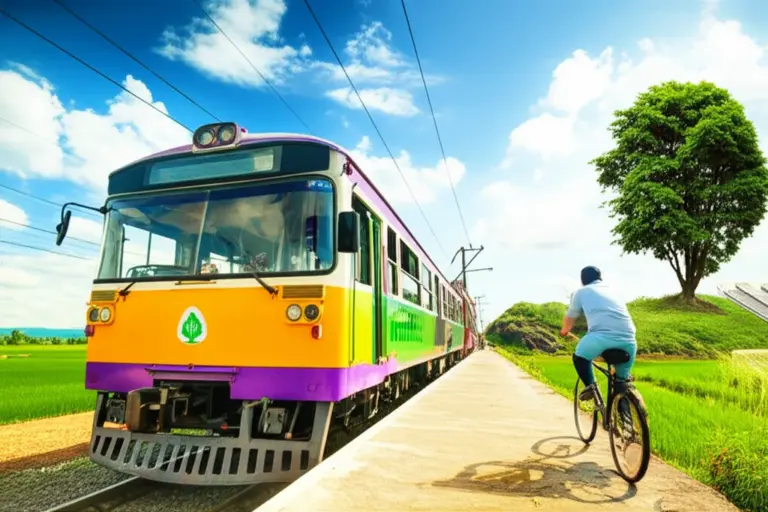
Train travel in Thailand offers a romantic, scenic, and significantly more eco-friendly alternative to flying. The State Railway of Thailand (SRT) operates routes connecting various regions, providing a unique perspective on the country’s diverse landscapes. [3]
Scenic Routes and Sleeper Trains
Popular routes, such as the journey from Bangkok to Chiang Mai, offer breathtaking views of rural Thailand, passing through lush rice paddies, mountains, and small villages. Overnight sleeper trains are a fantastic option, saving on accommodation costs while you travel. Waking up to a new landscape outside your window is an unforgettable experience. [5]
Benefits of Train Travel
- Lower Carbon Footprint: Trains generally emit significantly less CO2 per passenger-kilometer compared to air travel.
- Comfort and Space: More room to stretch out, walk around, and enjoy the journey.
- Scenic Views: Opportunity to witness Thailand’s diverse landscapes up close.
- Cultural Immersion: Interact with locals and experience a more authentic side of Thai life.
Biking Through Thailand: An Intimate Exploration
For the adventurous and those seeking a truly immersive experience, exploring Thailand by bicycle offers unparalleled freedom and a zero-emission mode of transport. This is perhaps the ultimate in low-impact transportation Thailand.
Urban Cycling and Bike Rentals
Many Thai cities, especially smaller ones and specific districts in larger cities, are becoming more bike-friendly. Renting a bicycle is often inexpensive and allows you to explore at your own pace, discovering hidden alleys, local markets, and charming neighborhoods that might be missed by other forms of transport. Bangkok’s ‘Green Lung’ (Bang Krachao) is a prime example of an area perfect for cycling, offering a tranquil escape from the urban hustle. [11]
Rural Routes and Multi-day Tours
Beyond urban centers, Thailand offers incredible opportunities for multi-day cycling tours, particularly in the northern regions with their scenic hills and cultural sites. Numerous tour operators specialize in guided bike trips that focus on cultural immersion and sustainable practices, often staying in local guesthouses and eating at community-run establishments. This supports local economies directly and provides a deeper connection to the country.
Safety Tips for Cyclists
- Wear a helmet: Essential for safety, especially in traffic.
- Be visible: Use lights and reflective gear, especially at dawn or dusk.
- Plan your route: Stick to quieter roads or dedicated bike paths where possible.
- Understand local traffic: Thai traffic can be chaotic; stay alert and predictable.
Understanding Carbon Offsetting for Your Thai Adventure
While choosing low-impact transportation Thailand significantly reduces your environmental footprint, some emissions, particularly from long-haul flights, are unavoidable. This is where carbon offsetting comes into play, offering a way to balance out your remaining emissions.
What is Carbon Offsetting?
Carbon offsetting involves investing in projects that reduce greenhouse gas emissions elsewhere to compensate for your own emissions. These projects can include renewable energy initiatives, reforestation efforts, energy efficiency programs, or methane capture projects. The goal is to achieve a net-zero emission by funding projects that remove or prevent an equivalent amount of carbon dioxide from entering the atmosphere.
Choosing Reputable Offset Programs
It’s crucial to choose reputable carbon offsetting programs that are certified by recognized international standards (e.g., Gold Standard, Verified Carbon Standard). These certifications ensure that projects are genuinely reducing emissions, are additional (wouldn’t have happened without the offset funding), and have positive social and environmental impacts. Many airlines now offer offsetting options, but independent platforms often provide more transparency and choice.
Combining Offsetting with Low-Impact Choices
Carbon offsetting should not be seen as a replacement for reducing emissions, but rather as a complementary measure. The most effective approach to responsible travel is to first minimize your emissions through choices like low-impact transportation Thailand, and then offset the unavoidable remainder. This dual strategy ensures you’re doing your utmost to travel sustainably.
Integrating Low-Impact Choices into Your Itinerary
Making responsible travel choices is easier than you might think with a little planning. By consciously integrating low-impact options, you can enjoy a richer, more meaningful journey through Thailand.
Planning Ahead
Before your trip, research public transport routes, train schedules, and bike rental options for your chosen destinations. Booking train tickets in advance, especially for popular sleeper routes, is highly recommended. Utilizing apps like Google Maps or local transport apps can help navigate bus and train systems in real-time. [7]
Supporting Eco-conscious Operators
When choosing tours or accommodations, prioritize those with strong sustainability policies. Many eco-lodges and tour operators actively promote low-impact transportation Thailand, support local conservation efforts, and engage with their communities. Look for certifications or clear statements about their commitment to responsible tourism.
By choosing these low-impact transportation options, you’re not just traveling; you’re making a positive impact. Your journey through Thailand can be an adventure that benefits both you and the beautiful country you explore. Embrace the slower pace, connect with the local culture, and leave behind nothing but footprints and fond memories.
คำถามที่พบบ่อย (FAQ)
References
- [2] Thailand Train First Timer’s Guide – YouTube
- [3] DO’S & DON’TS of TRAIN TRAVEL in THAILAND [Local Advice] – YouTube
- [5] How to take the Sleeper Train in Thailand (This Beats Flying!) – YouTube
- [7] Sustainable Thailand Journey: Sustainable Application – YouTube
- [8] BANGKOK BRT Line with Electric EV Bus Thailand – YouTube
- [10] Bangkok Transportation Guide | How To Get Around Thailand – YouTube
- [11] Sustainable Thailand Journey: Sustainable Tourism – YouTube
- Sustainable Travel in Thailand: Essential Tips to Minimize Your Environmental and Cultural Impact
- How to Choose Eco-Friendly Accommodations in Thailand (sustainable hotels, eco-lodges, community stays)
- Responsible Wildlife and Nature Activities: Ethical Tours and Marine Conservation Tips (no animal shows, coral-safe snorkeling)