Essential paddling techniques and beginner-to-intermediate skills to improve control and efficiency
- Essential paddling techniques and beginner-to-intermediate skills to improve control and efficiency
- Paddling Paradise in Thailand: Contextualizing Your Skills
- Mastering the Forward Stroke for Efficiency
- Essential Control Techniques: Steering and Maneuvering
- Intermediate Skills for Challenging Waters
- Safety First: Preparedness in Tropical Waters
- คำถามที่พบบ่อย (FAQ)
- Why is torso rotation important for paddling?
- What is the most common mistake beginners make when kayaking in Thailand?
- Do I need special gear to kayak in Thailand’s tropical waters?
Paddling Paradise in Thailand: Contextualizing Your Skills
Thailand offers some of the world’s most spectacular paddling environments, from calm turquoise lagoons to dynamic sea caves and channels. However, these environments also present unique challenges: sudden wind shifts, tidal currents, and the need for precision maneuvering around rock formations. Developing excellent control and efficiency ensures you can paddle longer, explore further, and conserve energy when facing unexpected conditions. The goal is to let your body, not just your arms, do the work.
Mastering the Forward Stroke for Efficiency
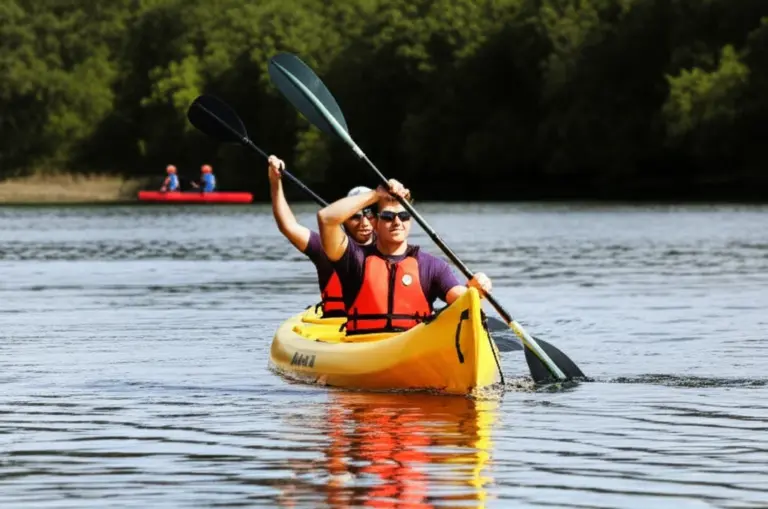
The forward stroke is the foundation of all paddling. Many beginners mistake this for an arm exercise, but true efficiency comes from engaging the core and legs. This is the first step in improving your control and reducing fatigue, vital for a full day of island hopping.
The Catch, Power Phase, and Recovery
- The Catch: Plant the paddle blade fully into the water near your toes. The key is to insert the blade completely before applying power.
- The Power Phase: Pull your body past the paddle, keeping the upper arm relatively straight. The power should come from rotating your torso, driving the hips and shoulders.
- The Recovery: Lift the blade cleanly from the water when it reaches your hip, preparing for the next stroke on the opposite side.
Proper Torso Rotation (The Engine)
Think of paddling as an unwinding motion. Instead of pulling with your biceps, you are pushing with your upper hand and rotating your core. This transfers power from your large leg and core muscles to the paddle, providing far more speed and endurance. When paddling through a strong headwind or against a tide near a Thai island, this rotational power is the difference between making progress and exhausting yourself quickly.
Watch this video demonstration to visualize the proper forward stroke and torso rotation:
Essential Control Techniques: Steering and Maneuvering
Control is paramount when navigating tight spots like the entrances to the famous ‘Hongs’ (sea caves) found in Phang Nga Bay. Beyond simple forward motion, you must master strokes that allow you to turn quickly, move sideways, and maintain stability.
The Sweep Stroke (Turning)
The sweep stroke is used for turning your kayak without losing forward momentum. Plant the paddle far out near the bow and sweep it in a wide arc towards the stern. A long, slow sweep on the right side will turn the boat sharply to the left. This is indispensable when making tight turns inside small lagoons or avoiding other tour boats.
The Draw Stroke (Moving Sideways)
If you need to move your boat directly sideways—perhaps to dock at a small beach or avoid an obstacle—the draw stroke is essential. Reach out sideways, plant the paddle vertically into the water, and pull the boat toward the paddle. This allows precise lateral movement, which is often needed in crowded tourist areas.
Low Brace (Stability and Confidence)
The low brace is a crucial safety skill. If a wave, a boat wake, or an unexpected shift in weight causes your kayak to tip, the low brace provides instantaneous support. Quickly slap the back of your paddle blade flat onto the water surface, leaning slightly into the brace. This creates a temporary floating platform, allowing you to recover your balance. Practicing this builds immense confidence, especially when paddling in open water.
Intermediate Skills for Challenging Waters
Once you have mastered the basics, focus on skills that enhance efficiency and safety in the variable conditions often encountered around the Andaman Sea.
Reading the Water and Currents
In areas like the Similan or Surin Islands, strong currents can develop between islands. Learn to identify eddies (swirls of water moving opposite the main current) and slack water (calm areas, often behind large rocks or points). Paddling in slack water or using eddies can save significant energy. Always plan your route using a tidal chart if you are paddling independently.
Feathering the Paddle (Dealing with Wind)
If paddling into a strong sea breeze—common during Thailand’s monsoon shoulder seasons—wind resistance on the non-immersed blade can be exhausting. Feathering means rotating the paddle shaft so the blade slicing through the air presents a narrow edge to the wind, drastically reducing drag and improving your efficiency. Most modern paddles allow you to adjust the feather angle.
Safety First: Preparedness in Tropical Waters
Tropical Safety Checklist
Before setting out on any Thai water adventure, ensure you have:
- A properly fitted Personal Flotation Device (PFD).
- Plenty of water (hydration is critical in the Thai heat).
- A dry bag containing a phone/communication device and emergency contact details.
- Knowledge of basic self-rescue techniques (e.g., how to re-enter your kayak if you capsize).
คำถามที่พบบ่อย (FAQ)
References
American Canoe Association (ACA) Resources on Paddling Technique