Why Ban Tha Sawang’s silk weaving matters: history, cultural significance, and what makes Surin silk unique
In the heart of Surin province lies a small village that has captured the world’s attention with its intricate threads and golden hues. Ban Tha Sawang is not just a settlement; it is a living museum of Thai craftsmanship. Ban Tha Sawang’s silk weaving represents the pinnacle of textile art, blending ancient Khmer techniques with local wisdom to create fabrics that are literally fit for royalty.
The Rich History of Surin Silk
The history of silk in Surin is deeply intertwined with the ethnic Kuy and Khmer people who have inhabited the region for centuries. Unlike the silk produced in other parts of Thailand, Surin silk—and specifically the output from Ban Tha Sawang—retains a distinct identity characterized by the ‘Yok Thong’ technique. This method involves weaving fine silk threads with silver and gold-coated silk strands, a practice that gained international fame when the village was commissioned to produce shirts and shawls for world leaders during the 2003 APEC summit.
What Makes Ban Tha Sawang’s Silk Weaving Unique?
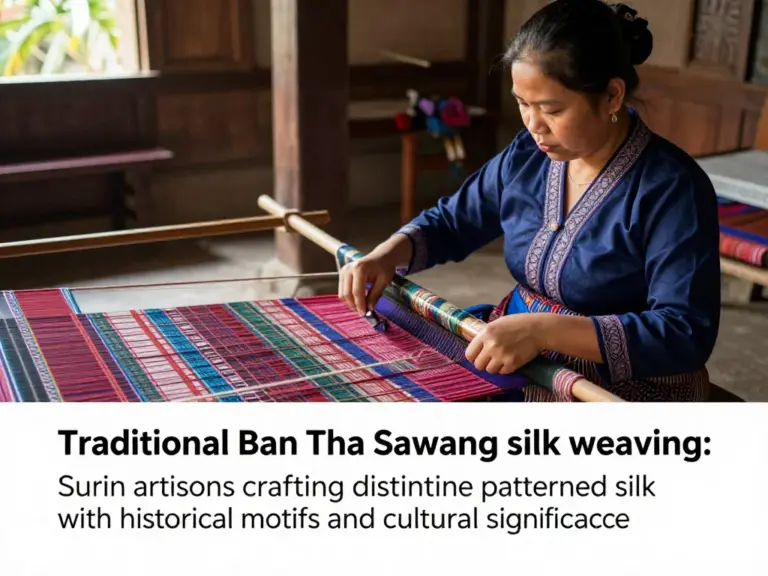
The uniqueness of Ban Tha Sawang’s silk weaving lies in its complexity. While standard weaving might use 2 or 4 pedals, the master weavers here utilize a specialized loom that can require up to 1,416 heddles. This allows for incredibly detailed patterns that appear almost three-dimensional. The process is so labor-intensive that a team of four weavers may only complete 4 to 5 centimeters of fabric in a single day.
Cultural Significance and the Preservation of Heritage
Beyond its aesthetic value, silk weaving is a cornerstone of Surin’s cultural identity. It is a communal activity that passes down through generations, ensuring that the ‘spirit’ of the ancestors remains alive in every thread. The village serves as a center for the ‘Chanroma Silk Weaving Group,’ led by Master Weaver Ajarn Weeratham Wichitjanthong, who has dedicated his life to reviving ancient royal weaving patterns that were nearly lost to history.
How to Visit Ban Tha Sawang
For tourists interested in Thailand’s cultural depth, a visit to Ban Tha Sawang is essential. Visitors can witness the entire production cycle—from the boiling of cocoons and spinning of silk to the mesmerizing rhythmic movement of the multi-pedal looms. It is a place where time slows down, and the clacking of the loom becomes a melody of heritage.
| Feature | Description |
|---|---|
| Primary Technique | Yok Thong (Gold Brocade) |
| Natural Dyes | Lac, Indigo, Tree Bark |
| Loom Complexity | Up to 1,416 heddles |
| Production Rate | ~5cm per day for complex patterns |
คำถามที่พ่อย (FAQ)
Q1: Why is Ban Tha Sawang’s silk weaving so expensive?
A1: The high cost reflects the extreme labor and skill required. Using thousands of heddles and gold-coated threads, a single piece can take months to complete.
Q2: Can I buy silk directly from the weavers?
A2: Yes, the village has a shop where authentic, high-quality silk products are available for purchase, supporting the local community directly.
Q3: Is Ban Tha Sawang open to tourists every day?
A3: Generally, the village is open daily during daylight hours, but it is best to visit during the morning when weaving activity is most frequent.
References
- Silk weaving and natural dye at Ban Tha Sawang Surin: A Complete Visitor’s Guide to Tradition, Techniques, and Cultural Experiences
- How natural dyeing works at Ban Tha Sawang: plant-based dyes, color extraction, and seasonal dye sources
- Hands-on experiences and workshops: what visitors can expect, booking tips, and ethical tourism practices