Which traditional games and activities are played during Hmong New Year in Phetchabun (patrol, ball-toss, and courtship games)?
- Which traditional games and activities are played during Hmong New Year in Phetchabun (patrol, ball-toss, and courtship games)?
The Hmong New Year, or ‘Noj Pe Hauv’, is the most significant annual festival for the Hmong community in Phetchabun province, particularly in the scenic highlands of Khao Kho and Phu Thap Boek. This celebration marks the end of the harvest season and the beginning of a new lunar cycle. Beyond the vibrant embroidered costumes and delicious traditional food, the festival is defined by its unique traditional games and activities. These games are not merely for entertainment; they serve as vital social conduits for courtship, community bonding, and the preservation of ancestral heritage.
The Heart of the Festival: Pov Pob (The Ball-Toss Game)
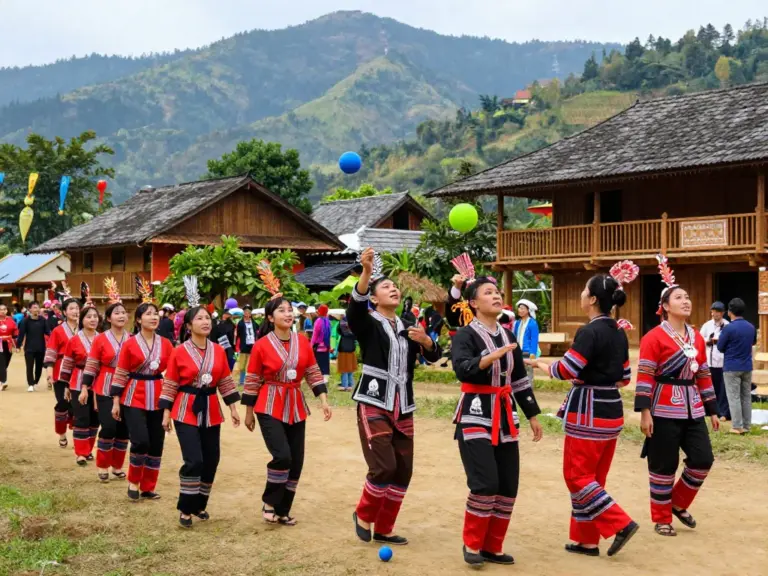
The most iconic activity during the Hmong New Year games in Phetchabun is Pov Pob, or the ball-toss game. This activity is the primary method of courtship for young Hmong men and women. Participants form two parallel lines—one of men and one of women—and toss a small cloth ball (pob) back and forth.
While the physical act of tossing the ball seems simple, the game is deeply symbolic. As the ball is exchanged, so are glances, smiles, and conversations. It provides a rare opportunity for young people from different villages to interact under the watchful eyes of their elders. If a participant drops the ball, they must traditionally forfeit an ornament or a piece of jewelry to their partner, which can later be ‘redeemed’ through singing or further conversation, deepening the social connection.
Traditional Patrol and Community Processions
In the context of Hmong New Year games in Phetchabun, ‘patrol’ activities refer to the ceremonial processions and village marches. During the festival, community members, dressed in their finest traditional attire, walk through the village or gathering grounds. This serves as a display of community strength and cultural pride.
These processions often involve the playing of the Qeej (a traditional Hmong reed pipe). The music of the Qeej is believed to communicate with the spirit world, and the skilled players perform acrobatic dances while playing, which is a spectacle of high technical skill and cultural significance. This ‘patrolling’ of the festival grounds ensures that every corner of the community is blessed for the coming year.
Spinning Tops and Marksmanship: Tuy Lub
While Pov Pob is focused on social interaction, Tuy Lub (top spinning) is a game of skill and competition predominantly played by men. The tops are hand-carved from hard wood and launched using a string attached to a bamboo stick.
The objective is to spin one’s top and then use it to strike an opponent’s top, either knocking it out of a designated area or stopping its rotation. This game demonstrates the precision and strength of the players. In Phetchabun, these competitions can become quite intense, drawing large crowds of cheering spectators. It is a testament to the physical prowess and hand-eye coordination valued in Hmong culture.
| Game/Activity | Primary Purpose | Participants |
|---|---|---|
| Pov Pob | Courtship & Socializing | Young Men & Women |
| Tuy Lub | Skill & Competition | Men/Boys |
| Qeej Performance | Spiritual & Artistic | Skilled Musicians |
| Bull Fighting | Traditional Spectacle | Community Gathering |
The Role of Courtship Games in Hmong Society
The courtship games during Hmong New Year in Phetchabun are essential for the survival of Hmong traditions. Historically, Hmong people lived in isolated mountain communities. The New Year festival was the only time people from various clans could meet. The structured nature of games like the ball-toss allowed for romantic interests to develop within the framework of cultural norms and respect. Even today, despite modern technology, these games remain a cherished way for the younger generation to connect with their roots and each other.
คำถามที่พบบ่อย (FAQ)
What is the most popular game during Hmong New Year?
The most popular and iconic game is ‘Pov Pob’ or the ball-toss game, which is central to Hmong courtship traditions.
When can I see these games in Phetchabun?
The games are played during the Hmong New Year festival, which typically occurs in late December or early January at locations like Khao Kho and Phu Thap Boek.
Can tourists participate in Hmong New Year games?
Yes, tourists are generally welcome to watch and sometimes participate in the ball-toss game, though it is important to be respectful of the cultural significance and traditional dress codes.
Why is the Qeej important during the festival?
The Qeej is a sacred instrument used to communicate with ancestors and spirits, providing the musical and spiritual backdrop for the New Year celebrations.
References
Tourism Authority of Thailand (TAT)
Cultural History of Hmong New Year