Seagrass Meadow Walk at Laem Ngop: A Guided Marine-Biology Experience for Eco-Tourists and Families
The coastal province of Trat, known primarily as the gateway to the Koh Chang archipelago, hides one of Thailand’s most vital ecological treasures: the vast seagrass beds of Laem Ngop. The Seagrass Meadow Walk at Laem Ngop offers a rare opportunity for visitors to step off the beaten path and into a living laboratory. This guided marine-biology experience is designed for those who seek to understand the delicate balance of our oceans while enjoying the serene beauty of the Gulf of Thailand.
The Ecological Importance of Seagrass in Trat
Seagrasses are often referred to as the ‘lungs of the sea.’ These underwater flowering plants form dense meadows that serve as critical carbon sinks, absorbing carbon dioxide significantly faster than tropical rainforests. In Laem Ngop, these meadows provide a nursery for juvenile fish, crustaceans, and the endangered dugong. During the Seagrass Meadow Walk at Laem Ngop, expert guides explain how these plants stabilize the seabed and filter nutrients, maintaining the water clarity that Thailand’s tourism industry relies upon.
A Hands-On Marine Biology Experience for Families
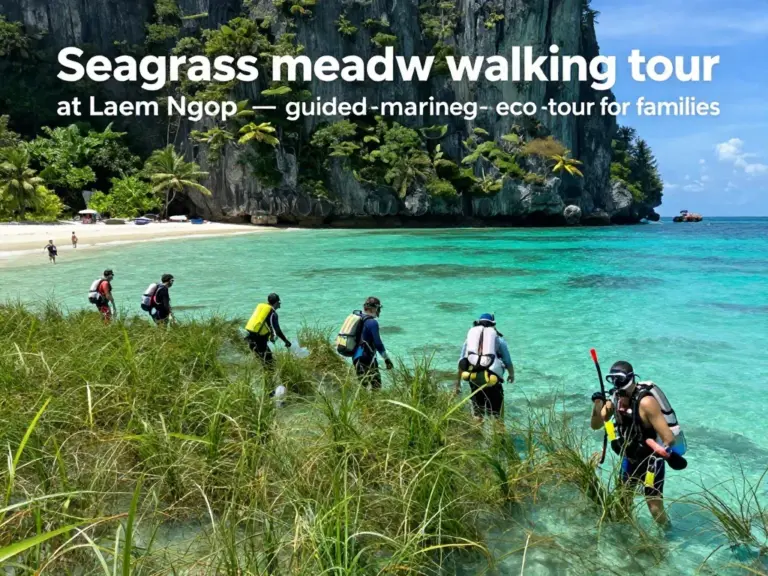
For families, this activity is an outdoor classroom like no other. Children can witness firsthand the biodiversity hidden beneath the surface. Using magnifying glasses and guided by marine biologists, participants can spot various species of sea cucumbers, colorful starfish, and tiny pipefish camouflaged among the blades of grass. It is an immersive way to foster environmental stewardship in the younger generation, moving beyond textbooks to a tactile, real-world encounter with nature.
| Species Often Spotted | Ecological Role |
|---|---|
| Sea Cucumber | Natural seabed filter/cleaner |
| Blue Swimming Crab | Key economic and predatory species |
| Enhalus acoroides | Large seagrass providing habitat |
What to Expect on Your Guided Walk
The journey typically begins at the Laem Ngop pier area, where local community leaders and conservationists meet guests. Participants are equipped with appropriate footwear—usually reef shoes or booties—to protect both their feet and the fragile ecosystem. The walk takes you several hundred meters out onto the exposed flats during low tide. The experience is slow-paced and meditative, focusing on observation rather than distance. Photographers will find the mirror-like reflections on the shallow water particularly captivating during the ‘golden hour.’
Supporting Community-Based Tourism
Choosing to participate in the Seagrass Meadow Walk at Laem Ngop directly supports the local fishing communities who have pivoted toward eco-tourism. By providing an alternative income stream, these programs incentivize the protection of the seagrass beds against industrial encroachment or destructive fishing practices. It is a shining example of how tourism can be a force for good, preserving natural heritage while empowering local people.
คำถามที่พบบ่อย (FAQ)
What is the best time of year to visit?
The best time is during the dry season, from November to April, when weather conditions are stable and water visibility is at its peak.
Is this activity suitable for young children?
Yes, children as young as five can enjoy the walk, provided they are supervised. It is an educational and safe environment during low tide.
What should I bring for the walk?
You should bring sun protection (hat and reef-safe sunscreen), a reusable water bottle, and a waterproof bag for your camera or phone.
How long does the guided experience last?
Typically, the guided marine-biology walk lasts between 1.5 to 2.5 hours, depending on the tide and the group’s interest level.
References
- Tourism Authority of Thailand (TAT) Newsroom
- Department of Marine and Coastal Resources (DMCR) Thailand
- IUCN – International Union for Conservation of Nature
- What to Expect on a Seagrass Meadow Walk at Laem Ngop — timing, meeting points, gear, accessibility, and safety guidelines for visitors
- Why Seagrass Meadows Matter — ecosystem services, species to spot (sea grasses, fish, invertebrates), and conservation importance in Trat Province
- Guided Tour Structure and Learning Opportunities — how marine biologists lead walks, typical teaching points, interactive activities, and citizen-science options